Discover 64 beautiful poetic words that will transform your writing and help you express emotions with precision and power. From blissful positives to haunting negatives, these carefully selected words will elevate your poetry and prose.
Powered by BAWT Writing Tools
Whether you’re crafting verses that rival Edgar Allan Poe or exploring iambic pentameter for the first time, poetry offers writers a powerful medium to express emotions beyond standard prose. The right words can transform ordinary thoughts into extraordinary expressions that resonate deeply with readers.
Writing compelling poetry requires more than rhythm and rhyme—it demands precise word choices that evoke specific emotions and paint vivid imagery. Having a curated collection of poetic words at your disposal can spark inspiration during creative blocks and help you articulate feelings that might otherwise remain unexpressed. Reading exceptional poetry can also inspire your own creative journey.
What Makes Words “Poetic”?
 Words like “bliss” carry emotional weight, painting vivid scenes and revealing character depth
Poetic words transcend simple communication—they create atmosphere, evoke emotions, and paint images in readers’ minds. These words often possess:
- Emotional resonance: They trigger specific feelings or memories
- Sensory appeal: They engage sight, sound, touch, taste, or smell
- Rhythmic quality: They flow naturally within verse structures
- Multiple layers: They carry both literal and symbolic meanings
- Memorability: They stick with readers long after the poem ends
The best poetic words work contextually—a word might be perfectly poetic in one setting but ordinary in another. Consider how words like “luminous,” “whisper,” or “cascade” immediately create mood and imagery compared to their plainer alternatives.
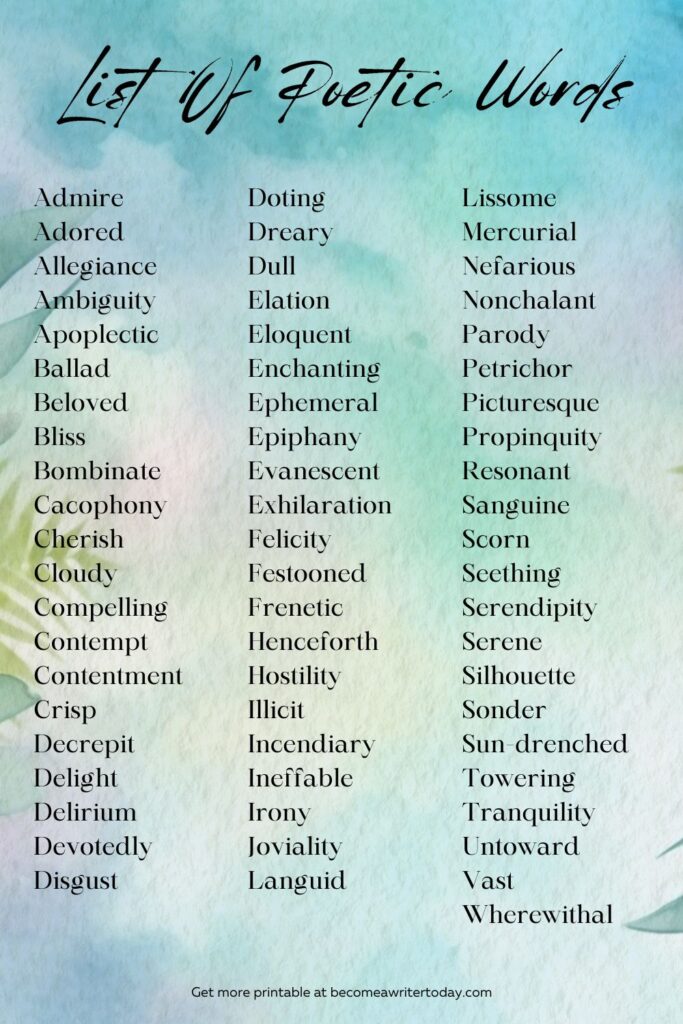
Complete Collection of 64 Poetic Words
Positive Words
Neutral Words
Evocative Words
Admire
Adored
Ballad
Beloved
Bliss
Cherish
Compelling
Allegiance
Ambiguity
Bombinate
Crisp
Ephemeral
Epiphany
Festooned
Apoplectic
Cacophony
Cloudy
Contempt
Decrepit
Delirium
Disgust
Contentment
Delight
Devotedly
Doting
Elation
Eloquent
Enchanting
Frenetic
Henceforth
Irony
Mercurial
Nonchalant
Parody
Petrichor
Dreary
Dull
Evanescent
Hostility
Illicit
Incendiary
Languid
Exhilaration
Felicity
Ineffable
Joviality
Lissome
Picturesque
Sanguine
Propinquity
Resonant
Silhouette
Sonder
Sun-drenched
Towering
Vast
Nefarious
Scorn
Seething
Untoward
Serendipity
Serene
Tranquility
Wherewithal
Positive Poetic Words: Expressing Joy and Beauty
When crafting poems about love, hope, or transcendent experiences, positive poetic words create warmth and emotional connection. These words should be used thoughtfully—their power comes from strategic placement rather than frequency. Explore our collection of beautiful words for additional inspiration.
Words of Love and Devotion
Admire – She couldn’t help but admire the prince as he took his place on the throne.
Adored – It was clear to his family that he simply adored her, flying across the country for her birthday party showed it.
Beloved – “You are my beloved, no matter what,” said the man at the airport to his wife as she dropped him off.
Cherish – “I’ll cherish this forever,” Donna said to her mother after unwrapping the heirloom earrings.
Devotedly – She devotedly stayed by her father’s bedside as his condition deteriorated, vowing to be there until his very last day.
Doting – He was a doting father, carefully ensuring his son’s bottles were prepared and his hair was combed nicely.
Words of Joy and Celebration
Bliss – Melanie relaxed in the chair on the deck, feeling like she was in a state of pure bliss.
Contentment – The sense of contentment Aliyah felt holding her newborn was unlike anything she’d ever experienced.
Delight – The puppy was a pure delight, and the parents couldn’t believe how thrilled their children were on Christmas morning.
Elation – She felt a sense of elation as they drove over the hill and the Ferris wheel finally came into view.
Exhilaration – Austin felt exhilaration as he finished his training run, imagining himself standing on the Olympic podium.
Felicity – The family fell into a state of felicity in their new home, enjoying dinner on the patio followed by evening walks.
Joviality – His joviality made him magnetic; even those closest to him struggled to remember when he was anything but happy.
Words of Beauty and Grace
Ballad – The newly married couple swayed as the ballad played softly in the background.
Compelling – His argument was compelling, and she decided it made sense to give him a chance for a second date.
Eloquent – Brittany was known for her eloquent speeches, and the crowd waited anxiously to hear what she would say.
Enchanting – The café was enchanting, with twinkling white lights and the wafting smell of coffee adding to the ambiance.
Ineffable – The size of the ocean was ineffable, and Dominique loved staring over the blue water, remembering how small she was.
Lissome – She looked lissome in her dress and was glad she chose a size that complemented her figure.
Picturesque – The picturesque beauty of the Adirondacks had to be seen to be believed, according to the tour guide.
Sanguine – The CEO felt sanguine about the company’s future, as things had finally begun to turn around.
Serendipity – They met by serendipity; their flights to different corners of the world happened to be leaving Chicago simultaneously.
Serene – The serene landscape of the lake made it easy for the family to relax and forget their troubles.
Tranquility – The ocean view filled Tom with a sense of true tranquility.
Neutral Poetic Words: Creating Balance and Atmosphere
These words possess inherent rhythm and flow that lends them naturally to poetry while remaining emotionally ambiguous. They’re perfect for balancing more intense emotional language and creating atmospheric depth in your verses.
Words of Time and Change
Ephemeral – The cronut trend was ephemeral, disappearing after a few months, but it was delicious while it lasted.
Evanescent – The bubbles the children blew were delightfully evanescent, bursting just before drifting out of sight.
Henceforth – The local HOA declared that henceforth, no one could put trash at the curb more than 24 hours before pickup.
Mercurial – Like most teenagers, her mood was mercurial and could change at any moment.
Words of Place and Sensation
Bombinate – The bombinating coffee machine had the entire office waiting to try the new flavor the boss picked up.
Crisp – As she laced up her sneakers, she smiled at the crisp breeze that meant fall was just around the corner.
Petrichor – She opened the kitchen windows to let in the petrichor air that accompanied the thunderstorm.
Resonant – The church bells were resonant at noon and could be heard echoing throughout the village.
Sun-drenched – The sun-drenched backyard was perfect for the friends to try out their new water guns.
Words of Connection and Relationship
Allegiance – Teresa felt strong allegiance to the company, as they had supported her during hard times.
Propinquity – Her propinquity to her neighbors meant she always had someone to depend on in a pinch.
Sonder – Walking along the ocean, he was filled with sonder, thinking about everyone else who had walked the same path.
Words of Understanding and Perception
Ambiguity – She was purposely ambiguous when he asked whether she still loved him, unsure of the correct answer.
Epiphany – When she woke up, she had a beautiful epiphany: if she wanted to move to the coast, she could make it happen.
Irony – She felt profound irony when she realized the laws she’d fought to enact would work against her.
Nonchalant – The rabbit was decidedly nonchalant as he munched clover in front of the museum.
Parody – The movie was a parody of the original, and moviegoers loved seeing inside jokes from their favorite films.
Words of Form and Appearance
Festooned – She festooned her balcony with hanging baskets and a new patio set.
Frenetic – While her teaching methods were solid, her pace was frenetic, and students struggled to keep up.
Silhouette – He noticed her slender silhouette even before he noticed her beautiful face.
Towering – At 7’2″, Brandon was towering over every member of the opposing team.
Vast – The vast prairie landscape was pleasantly overwhelming, with wheat fields stretching as far as the eye could see.
Wherewithal – Kendra wasn’t sure she had the wherewithal to attend a family reunion following a 24-hour nursing shift.
Evocative Poetic Words: Expressing Intensity and Conflict
Poetry often serves as an outlet for processing difficult emotions. These words help readers connect with experiences of anger, sadness, grief, and other challenging feelings that are essential parts of the human experience.
Words of Anger and Rage
Apoplectic – Billy was apoplectic with rage when he learned he’d been passed up for the promotion he’d worked toward all year.
Contempt – Despite her efforts to forgive, Andrea was full of contempt for her former best friend after learning of her lies.
Incendiary – His language toward the government was downright incendiary, and he began to lose supporters.
Scorn – Karen knew using technology would further her career, but she tended to scorn anything new and different.
Seething – She was seething! She couldn’t believe her sister was stealing from their grandfather’s estate.
Words of Decay and Deterioration
Decrepit – The decrepit old house was supposedly haunted, but Megan and her cousin decided to explore anyway.
Dreary – The dreary sky matched Matt’s mood, as he was feeling down about the negative review at work.
Dull – Ian was downright dull and made no effort to add any excitement to his life.
Languid – The flu left her feeling languid and exhausted, struggling to keep up with her job’s demands.
Words of Confusion and Disarray
Cacophony – The cacophony of the play area made it almost impossible for the babysitter to think straight.
Cloudy – She knew she couldn’t trust her feelings at the moment; they were too cloudy.
Delirium – Naomi felt like she was entering delirium as the anesthesia took effect, but thankfully drifted off quickly.
Words of Darkness and Danger
Illicit – Bringing illicit substances onto an aircraft is a fast way to get a one-way ticket to prison.
Nefarious – As she pulled into her driveway, she struggled to see whether the person on her doorbell camera was nefarious.
Untoward – Melody tried to act as if his behavior hadn’t been untoward, but she had trouble respecting him.
Words of Revulsion and Rejection
Disgust – “I’m disgusted,” the teacher said when addressing the class about their behavior with the substitute.
Hostility – The hostility in the room was palpable, and no one knew how to calm the tension between the adversaries.
How to Use Poetic Words Effectively
Choose precision over abundance: One perfectly chosen poetic word often has more impact than several mediocre ones. Consider how “luminous” creates a specific image compared to simply “bright.”
Consider context and tone: A word like “ephemeral” might be perfect for a contemplative piece about time’s passage but jarring in a lighthearted love poem.
Read aloud for rhythm: Poetic words should enhance your poem’s musical qualities. Test how they sound when spoken to ensure they flow naturally with your meter and rhyme scheme.
Layer meanings: The best poetic words work on multiple levels—literal, emotional, and symbolic. “Cascade” might describe both falling water and overwhelming emotions.
Trust your instincts: If a word feels forced or pretentious in context, choose something simpler. Authenticity trumps sophistication in effective poetry.
Building Your Poetic Vocabulary
Developing a rich vocabulary for poetry is an ongoing process. Read widely across different poetic traditions and time periods. Keep a notebook of words that strike you as particularly evocative or musical. Practice using new words in different contexts until they feel natural.
Remember that the most powerful poetic words are often those that surprise readers while feeling inevitable in context. The goal isn’t to impress with obscure vocabulary but to find the exact words that bring your vision to life.
For more inspiration in exploring poetic language, check out our guide with examples of mood in poetry to see how word choice shapes emotional atmosphere.
Conclusion: The Power of Precise Language
These 64 poetic words represent tools for emotional precision—each one capable of evoking specific feelings, painting particular images, or creating unique atmospheric effects. Whether you’re expressing the ineffable joy of new love, the serene beauty of nature, or the seething intensity of betrayal, the right word choice can transform ordinary thoughts into memorable poetry.
Use this collection as inspiration rather than prescription. The best poems emerge when authentic emotion meets precise language. Let these words spark your creativity, but never let them overshadow your unique voice and perspective.
Poetry’s greatest power lies in its ability to make readers feel less alone in their experiences. When you find the perfect poetic word to express something previously inexpressible, you create a bridge between your inner world and your reader’s understanding—and that’s where the true magic of poetry lives.